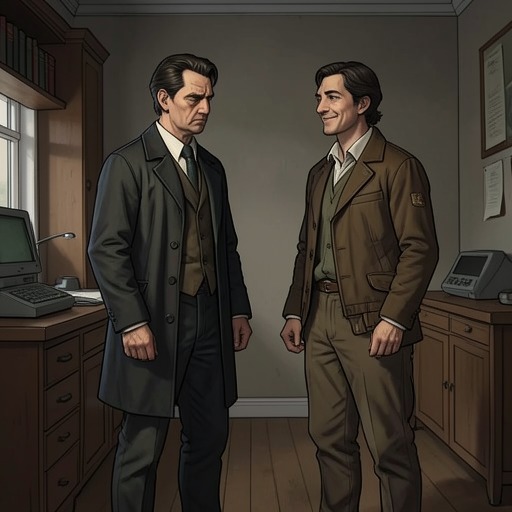
Toru Watanabe
Norwegian WoodToru Watanabe is the first-person narrator and central consciousness of Norwegian Wood, a survivor whose effort to understand the dead becomes the act of telling the story. The novel begins with him at thirty-seven, arriving at Hamburg Airport in November; the Beatles’ “Norwegian Wood” stirs memories with unusual force, and he explains that writing is how he tries to comprehend what has happened. The resulting account follows a young man learning that grief cannot be held at a safe distance from life.
Identity and the Act of Remembering
At the novel’s opening, Toru is strapped into a 747 descending through dense cloud toward Hamburg Airport. The rain, the airport buildings and the sight of a BMW billboard give the scene an impersonal, wintry cast. Once the plane lands, an orchestral cover of “Norwegian Wood” comes through the cabin speakers. The music has always made him shudder; this time its effect is stronger than ever, and the memory it opens becomes the reason he writes.
Toru describes writing as a way to think and to understand. He says that he has to put things down in words before he can feel that he fully comprehends them. The book is therefore not simply a recollection of his youth: it is an older man’s attempt to give shape to experiences that still press upon him. Its narrative returns to the past from the distance of the Hamburg flight, but that distance has not made the past emotionally remote.
The remembered scene of the meadow shows how recollection can absorb another person’s image. Toru cannot say whether the field well Naoko described actually existed, or whether it lived only in her mind. Yet after hearing about it, he could no longer recall the meadow without the well. He remembers it as a dark, grass-hidden opening, roughly a yard across, precisely where the meadow met the woods. The well’s uncertain reality does not weaken its hold on his memory; it becomes inseparable from the place he saw.
Learning to Live with Death
After beginning a new life in the dormitory, Toru tries to stop taking everything so seriously and to establish distance between himself and the world. He attempts to forget particular images: pool tables, a red N-360, white flowers on a school desk, smoke from crematorium chimneys, and paperweights in police interrogation rooms. For a time, the effort seems to work. But a vague inner knot remains, gradually taking on a form he can put into words.
That understanding is that death exists not as life’s opposite but as part of life. Toru recalls that he once regarded the two as separate: death would eventually take people, but until then, life and death seemed to occupy different territories. His later recognition reverses that simple division. Death is already present in the objects and scenes of ordinary existence, and the living continue to breathe it in like fine dust. The insight does not resolve grief; it changes the terms on which he understands being alive.
This idea also clarifies the novel’s contrast between forgetting and remembering. Toru attempts to detach himself from painful images, yet they persist, and memory gives them new forms rather than erasing them. The meadow and its imagined well become one such fusion. His act of narration makes that persistence visible: the past is neither restored intact nor left behind, but repeatedly encountered in the present.
Toru among the Living
In one dormitory roll call, a young woman asks why he failed to answer when his name was called and confirms him as Toru Watanabe. His brief acknowledgment gives the name around which the novel’s inward narrative is organized. Elsewhere, the older narrator uses that name at the gate of Ami Hostel. A gatekeeper arriving on a yellow bicycle checks it by telephone and directs him to Doctor Ishida, marking the practical threshold through which Toru enters the world where Naoko is living.
During that visit, Toru admits to Reiko that he remains unsure whether what happened between him and Naoko in Tokyo was right. Reiko says that she and Naoko are unsure too; the two of them will have to decide what happened and whether they can reach some mutual understanding. Her answer leaves the question open rather than settling it on Toru’s behalf. He is not given a simple judgment that would free him from responsibility or doubt.
His connection with Midori develops alongside this attachment to the past. After a sleepless night spent thinking about Naoko, Toru swims several lengths of a fifty-metre pool, eats lunch, and heads toward the literature library. He encounters Midori Kobayashi with another girl, but Midori approaches him alone. The sequence sets bodily routine and a chance meeting against the private intensity of his memories: he continues to move through ordinary days even while the past occupies his mind.
When Midori turns a Sunday conversation toward sexual subjects, Toru says he would rather discuss something else and asks whether her boyfriend attends their university. She explains that he attends a different university and that they met through a joint school-club activity before becoming serious after their examinations. The exchange reveals Toru’s attention to the conditions of Midori’s relationship, while also showing that their intimacy develops through talk that can shift between teasing, candor and discomfort.
Choices, Conflict, and an Unfinished Future
Toru’s involvement with Nagasawa exposes a conflict between his conduct and the standards he would like to uphold. At a dinner where Nagasawa’s drunken meanness is directed at Hatsumi, Toru finds it increasingly difficult to remain seated. When Hatsumi asks what happened during a night out, he explains that he and Nagasawa met two women in a Shibuya bar, went with them to a hotel and slept with them; later, Nagasawa proposed that the two men switch rooms and partners. Toru’s plain account does not erase his participation. The episode sets the disquiet he feels beside the choices he made within Nagasawa’s way of life.
Later, Toru and Midori meet again in the rain. She tells him that on the night she last saw him, she spoke to her boyfriend and they broke up. Toru tells her that he loves her and does not want to let her go again, but says he cannot make a move because of Naoko. The confession brings his competing attachments into the open without resolving them: Midori’s availability does not cancel his bond with Naoko, and love does not immediately produce a clear choice.
The older Toru’s effort to write and the younger Toru’s hesitation belong to the same unfinished process. The music at Hamburg Airport makes the remembered past forceful again; the act of writing gives him a way to approach it, but not to turn loss into a closed chapter. His defining movement is from trying to keep death and suffering at a distance toward acknowledging their presence in life, while continuing to seek connection with those who remain.